
Ouadane

The historic town of Ouadane

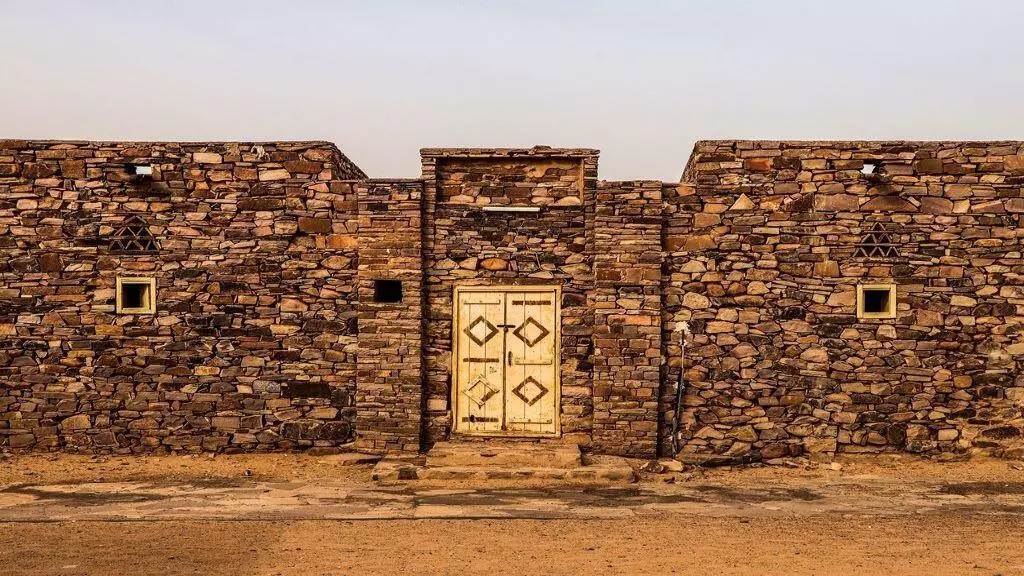
Ouadane is an ancient archaeological site perched on the edge of an escarpment on the plateau of the wilaya of Adrar, in northern Mauritania. Founded in 536 AH (1142 CE), it served as a prominent stop for Saharan trade caravans and a major centre of scholarly influence.

The history of Ouadane

Foundation: the town was founded in 536 AH by three founders — El Hadj Ali al-Sanhaji, El Hadj Yacoub al-Qurashi and El Hadj Ousmane al-Ansari.

The golden age: in the Middle Ages it became a principal meeting point for trade caravans arriving from the Maghreb, Egypt, Sudan and the Hijaz.

Learning and knowledge: it was nicknamed the town of the "forty scholars," owing to the great number of its learned men and jurists, renowned for teaching, authorship and travel literature.

World listing: the historic town was inscribed, together with its counterparts (Chinguetti, Tichitt and Oualata), on UNESCO's World Heritage list.

The principal monuments

The great wall: it encircles the old town, standing 4 metres high and 1.5 metres thick, built of stone and clay to protect it more than nine centuries ago.

The "Foum el-Mabrouk" gate: the largest of the historic wall's gates, it was the main entrance for caravans coming from the east.

The fortified well: an old well sunk inside the wall to supply the inhabitants with water during periods of siege or war.

The Street of the Forty Scholars: an ancient street commemorating the forty scholars who gathered and agreed to found — or to serve — learning in this place.

The old mosque: notable for its ancient minaret, among the oldest in the region.

What to see

Natural

Tenlabaa

Tenlabaa (often spelled Tinlaba or Tin Labbé) is a village and a large oasis in Mauritania, located in the department of Ouadane, within the region (wilaya) of the Adrar. A major, modern oasis Date palm cultivation: The oasis has around 20,000 date palms producing more than 200 tonnes of high-quality dates a year. A pilot oasis: A modern extension in the form of a pilot oasis of 30 to 50 hectares has been developed there, equipped with irrigation networks, solar-powered boreholes and water reservoirs. Market gardening: In addition to dates, the inhabitants grow traditional market-garden crops (vegetables) in the shade of the palms. Location: The village lies in the immediate vicinity of the historic city of Ouadane, listed as a UNESCO World Heritage Site. A trekking stage: It is an essential waypoint for caravan treks, 4x4 circuits and travellers exploring the canyons and dunes of the Adrar.

Historic

Agouadir

The historic site of Agouadir (or Agueidir, Aguidir), located in the Adrar region of Mauritania, is an ancient fort and Saharan archaeological site. The term agadir or agouadir historically denotes, in the Berber language, a fortified granary or a defensive structure. The place embodies the military and commercial importance of the region on the old trans-Saharan caravan routes. The history of Agouadir and the Adrar Berber and Almoravid origins: The name recalls the influence of the Berber tribes and the Almoravid expansion that marked the Adrar region. A defensive structure: The site is recorded as an ancient fort or fortified strategic encampment, used to protect goods and control the passages across the tabular plateau of the Adrar. A caravan crossroads: It belongs to the historic network linking the great cities of the region such as Ouadane, Chinguetti and Azougui. Tourism potential and nearby attractions Today, Agouadir forms part of the Saharan and cultural tourism circuits for which the wilaya of the Adrar is renowned. Travellers usually reach it setting out from the town of Atar. Desert tourism: The site is visited on walking treks, 4x4 expeditions or camel treks across the black rock canyons and the ochre dunes of the Warane erg.