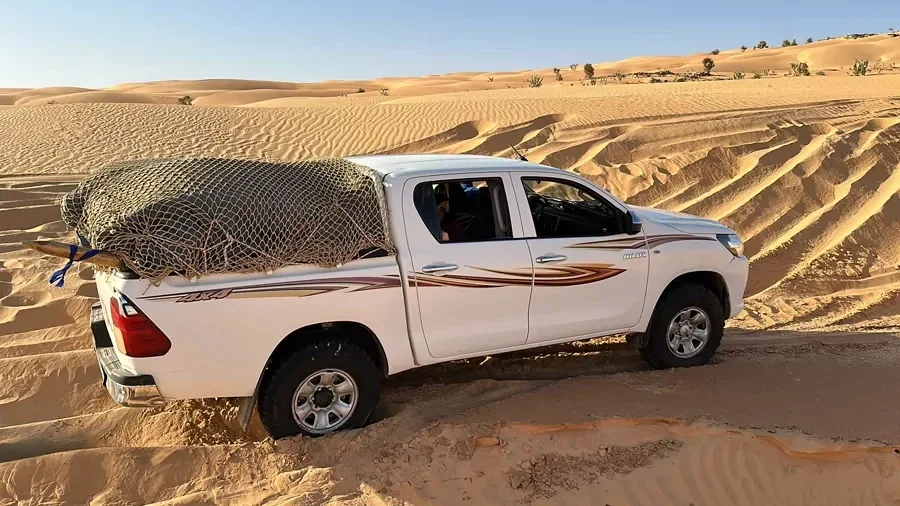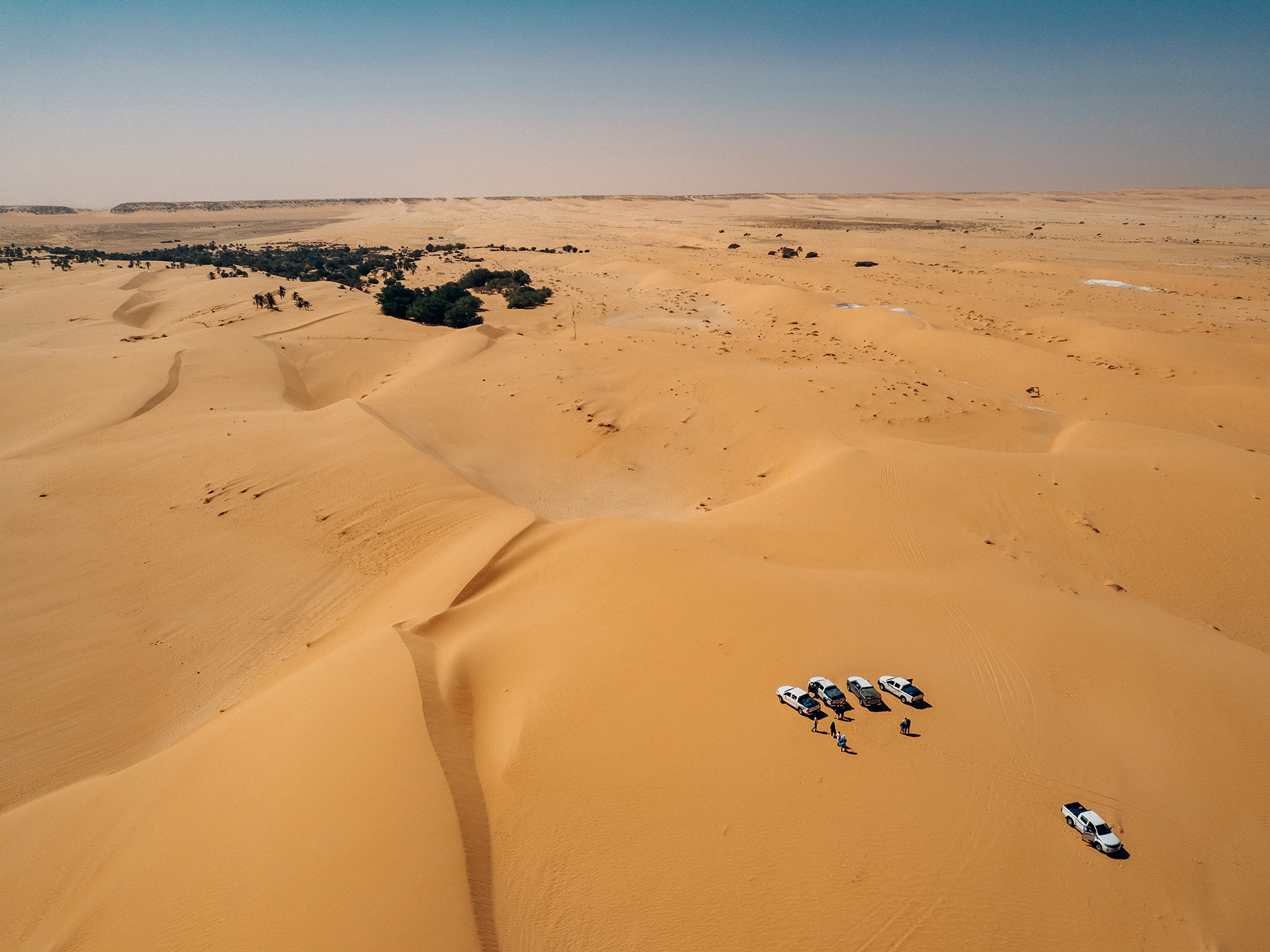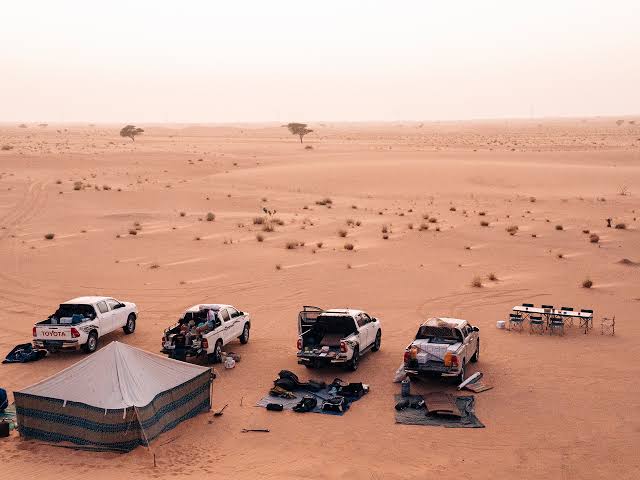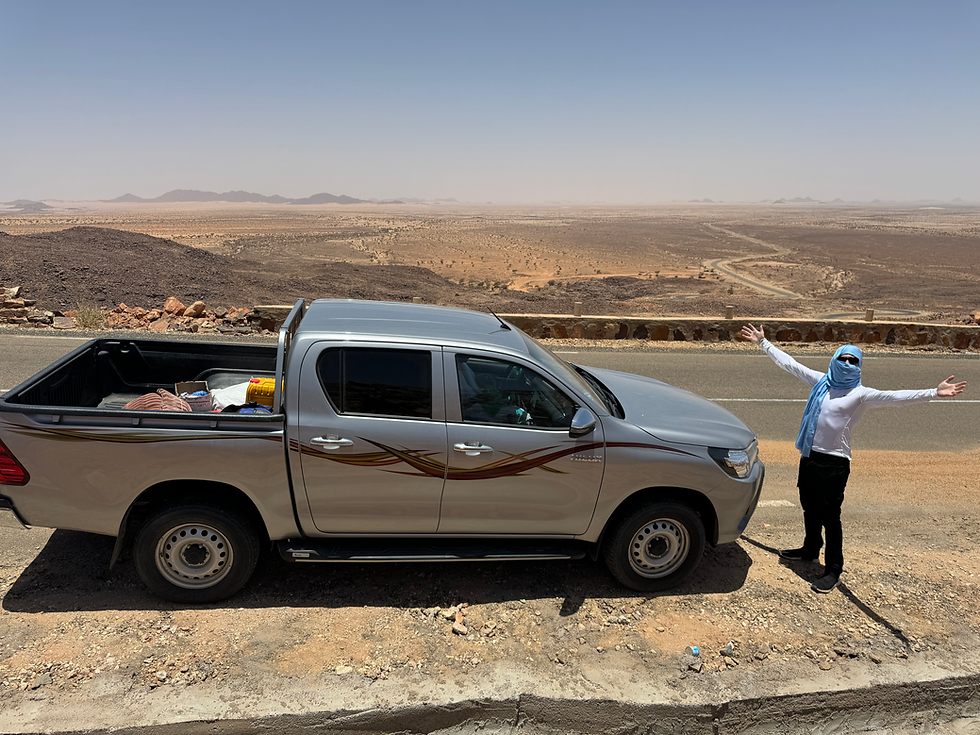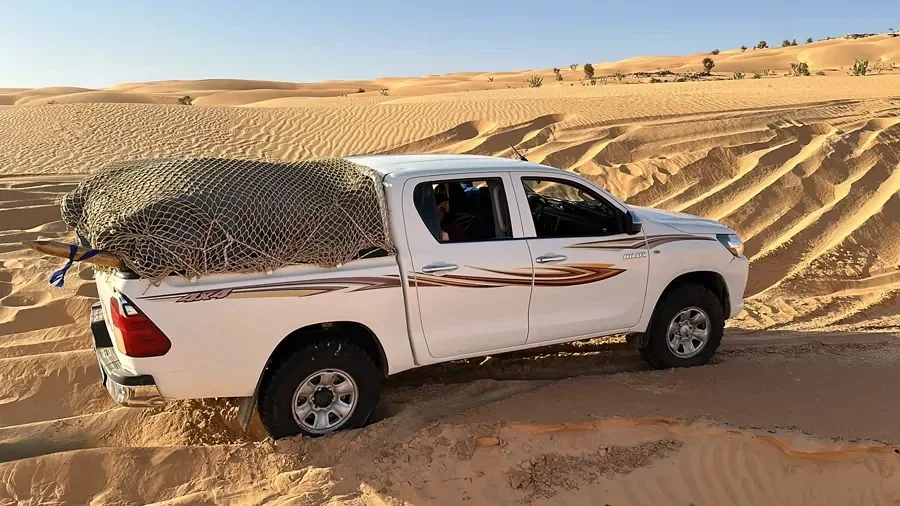
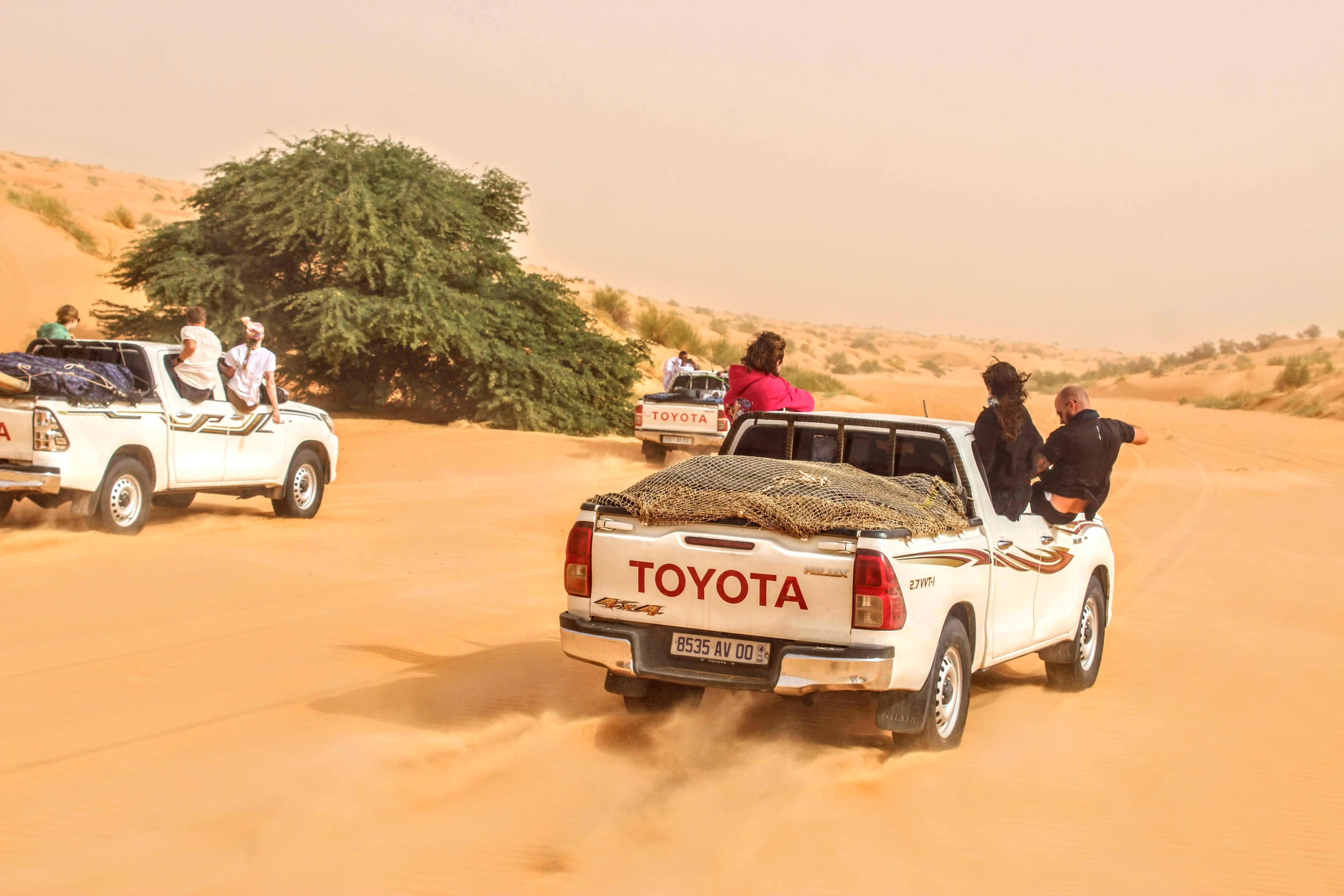
A complete crossing of Mauritania's greatest landscapes in ten days and nine nights, round trip from Nouakchott: the capital and its markets, the giant dune of Azoueiga, the oases of Terjit and M'Heirith, the medieval caravan cities of Chinguetti and Ouadane, the Eye of the Sahara (Richat Structure), Azougi, first capital of the Almoravids — and the legendary ride on top of the iron ore train, one of the longest trains in the world, across the open desert to the Atlantic coast. Route: Nouakchott – Akjoujt – Azoueiga Dune – Terjit – Chinguetti – Ouadane – Richat Structure – Atar – Azougi – Choum – Iron Ore Train – Nouadhibou – Nouakchott. Transport by private 4x4 convoy with experienced desert drivers, and one night on the iron ore train. Accommodation: hotels in Nouakchott and Nouadhibou, guest houses (auberges) in Chinguetti and Ouadane, traditional desert camps at Azoueiga and Azougi, and one open-air night on the train. Full board on the road: Mauritanian dishes (tagine, grilled meat, fresh fish on the coast), dates, camel milk and endless rounds of mint tea. Highlights: camel market · Azoueiga dune camp · Terjit oasis · Chinguetti manuscripts · Richat Structure · rock art of Amogjar · Almoravid ruins of Azougi · iron ore train under the stars.
Itinerary
-
1
Arrival in Nouakchott
Nouakchott →Welcome to Mauritania! On arrival at Nouakchott–Oumtounsy International Airport you will be met by our team and transferred to your hotel in the city. After the journey, the rest of the day is yours to relax, freshen up and recover.
In the evening we gather for a welcome dinner: you will meet your guides and drivers — the crew who will take care of you for the whole trip — and we will walk through the route, the desert days ahead and any last questions.
About Nouakchott: Nouakchott ("the place of the winds") is one of the youngest capitals in the world. In 1958 it was a small coastal village of a few hundred people; today it is home to well over a million inhabitants and is the political, economic and cultural heart of Mauritania. The city sits where the Sahara meets the Atlantic — sand dunes literally drift into its outer streets — which gives it a character found nowhere else in the region.
Night: hotel in Nouakchott.
-
2
Exploring Nouakchott
Nouakchott →A full day discovering the capital's most fascinating corners — a perfect introduction to Mauritanian life before we head into the desert.
The Saudi Mosque (King Faisal bin Abdulaziz Mosque): the most imposing building in central Nouakchott, built with financial assistance from the Kingdom of Saudi Arabia. Its sand-coloured, ornate structure and twin high minarets dominate the skyline, and it has long served as a primary centre of religious life in the capital. We admire the architecture from outside and stroll the lively surrounding streets.
The Camel Market: about ten kilometres from the city centre, the buildings recede to reveal the world's second largest camel market. Hundreds of dromedaries stand divided neatly into herds by their herders, who trade, bargain and negotiate exactly as their ancestors did. In Mauritania the dromedary is an emblematic animal — transport, milk, meat and wealth all in one — and this market is the best place in the country to feel how central it remains to daily life. Expect noise, dust and unforgettable photographs.
The Fish Market (Port de Pêche): one of the most spectacular sights in West Africa. In the late afternoon hundreds of brightly painted wooden pirogues surf through the Atlantic waves and land directly on the beach, where teams of men haul the catch ashore by hand. Mauritania's waters are among the richest fishing grounds on earth: the fisheries sector contributes roughly 3% of national GDP, around 20–25% of exports, and supports tens of thousands of jobs, mostly artisanal. Watching the whole chain — unloading, sorting, salting and drying — happen on the open sand is pure living theatre.
The National Museum of Mauritania: housed in a 1972 building constructed with Chinese cooperation, the museum is the country's premier repository of history and culture. Its archaeological and ethnographic exhibits chronicle millennia of human habitation in the region — from Neolithic tools and rock-art reproductions to the tents, jewellery, dress and daily objects of Moorish nomadic society. An excellent key to understanding everything we will see later in the Adrar.
Evening: dinner of local dishes served in a traditional tent, with the chance to taste fresh camel milk — the drink of the desert.
Night: hotel in Nouakchott.
-
3
North into the Sahara: the Great Dune of Azoueiga
The Great Dune of Azoueïga →Distance: approx. 415 km on the road, then desert tracks · Driving time: 5–6 hours plus off-road section.
We leave Nouakchott on the N1 highway heading north-east towards the Adrar region. The landscape empties fast: flat white plains, scattered acacias, camel herds on the horizon.
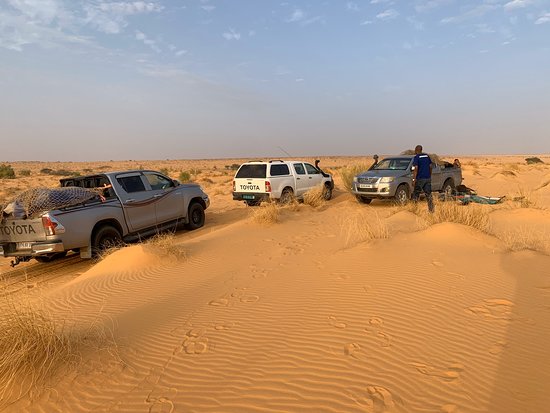
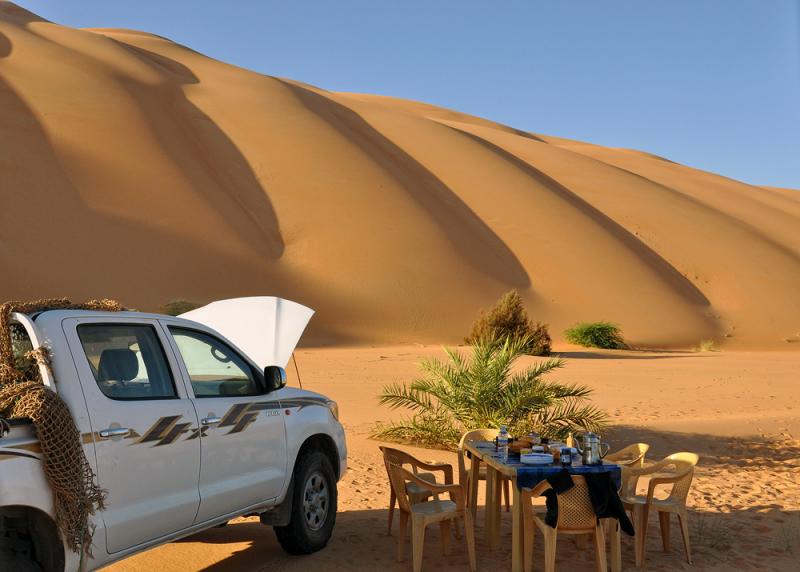
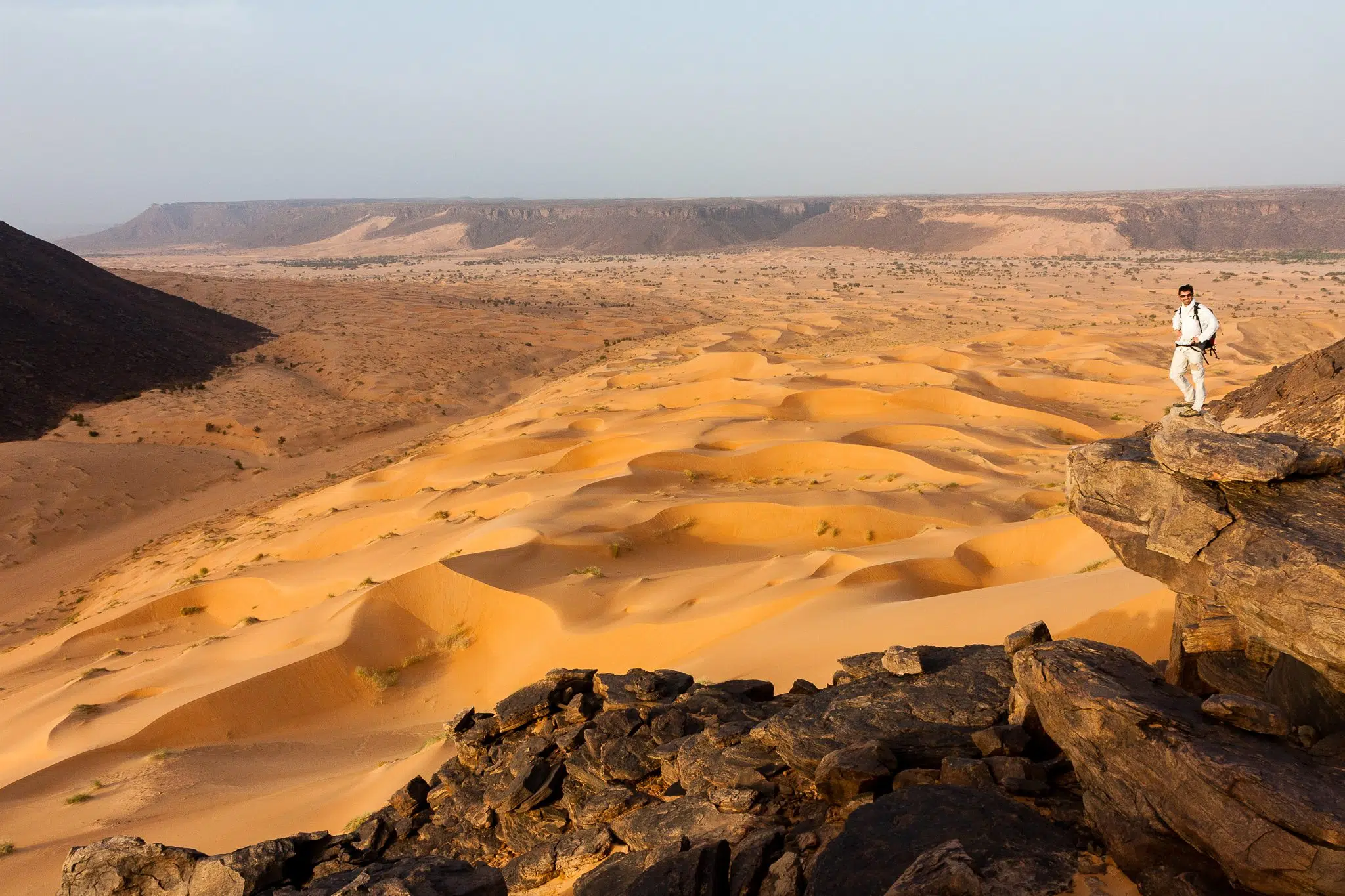
Pit stop in Akjoujt: roughly halfway (about 250 km), we pass through this mining town — the place to stretch your legs, refill water and buy last-minute supplies. Then lunch in the desert: a first taste of the expedition rhythm — a shaded spot, a carpet, fresh tea. And into the dunes: our 4x4 convoy leaves the asphalt and makes a beeline across open Sahara for the great Dune of Azoueiga, which we will attempt to climb for sunset over an ocean of sand.
About Akjoujt and the Azoueiga Dune: Akjoujt, capital of the Inchiri region, has lived from its mineral wealth for decades — copper and gold are mined here today, and the surrounding hills were exploited for copper as far back as antiquity. The Azoueiga dune is one of the tallest free-standing dunes in this part of the Sahara — a mountain of golden sand rising abruptly from the plain. Climbing its ridge is a real effort, but the reward is a 360° panorama of untouched desert; running or rolling back down is pure childhood joy.
Night: traditional camp in local tents at the foot of the dune — dinner cooked over the fire and a sky absolutely saturated with stars.
-
4
Oases of Terjit and M'Heirith, and the Disappearing City of Chinguetti
Chinguetti →After a hearty breakfast at camp we continue through the Sahara — today with the opportunity to swim in a natural oasis!
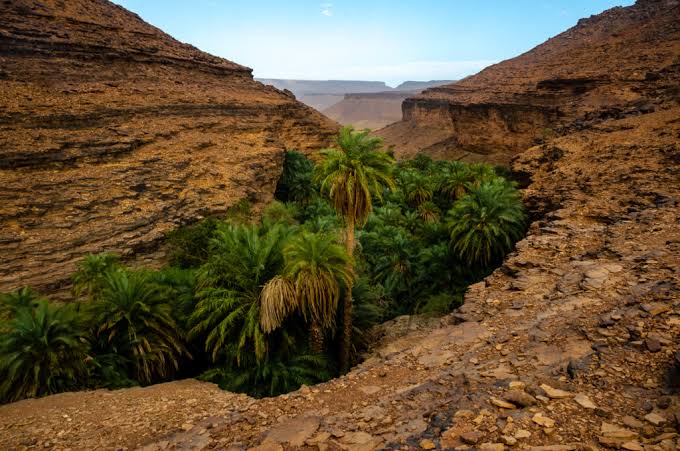
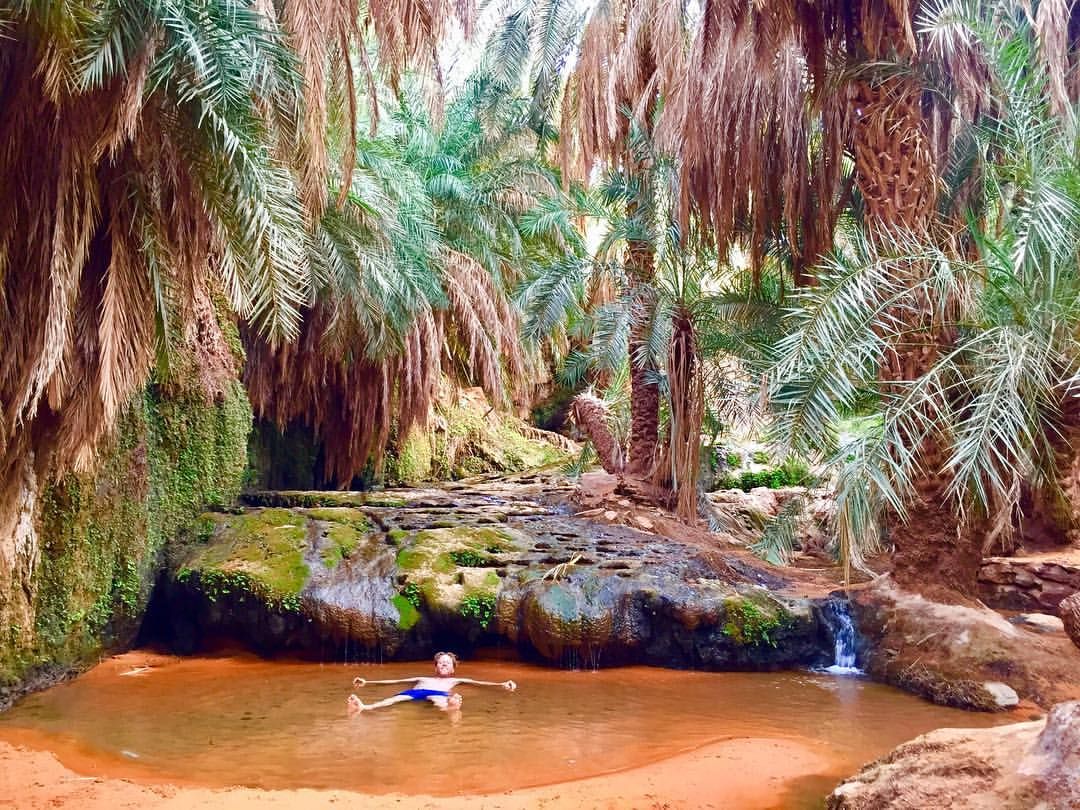
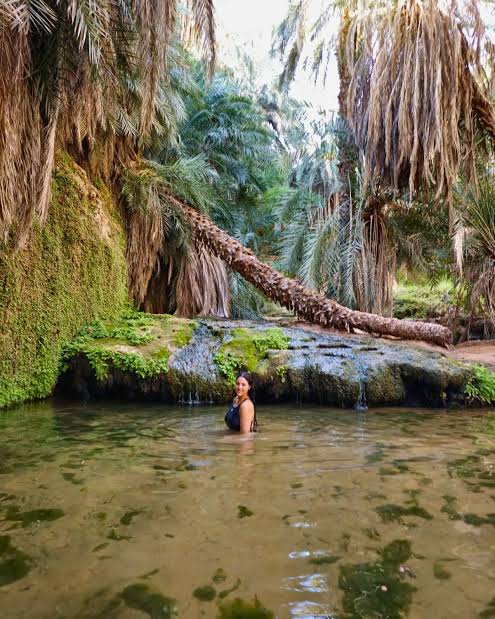
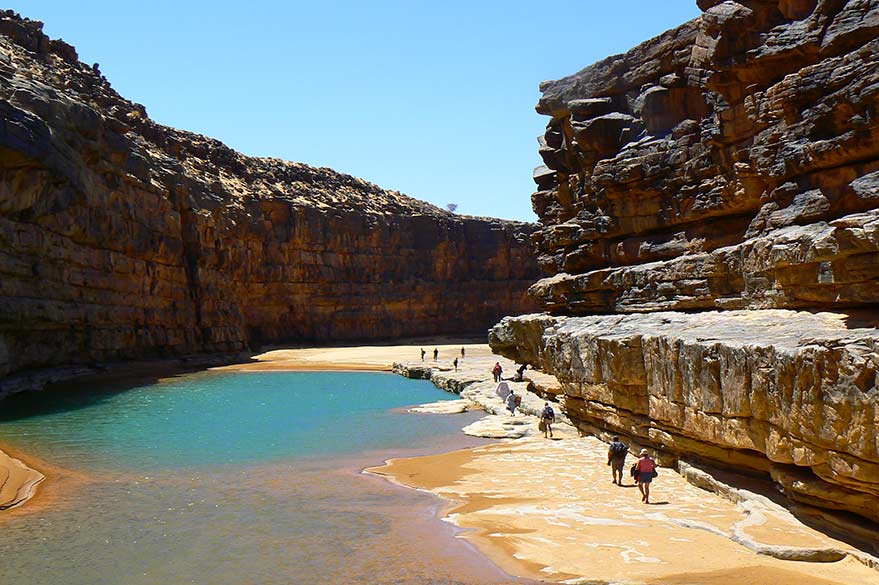
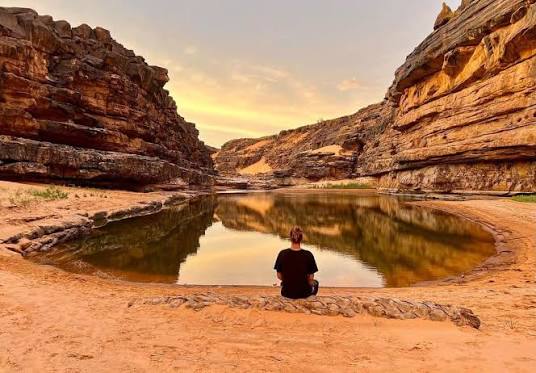
Terjit Oasis: hidden in a narrow gorge on the edge of the Adrar plateau, Terjit is the most famous oasis in Mauritania — for centuries a resting place of caravans, and by tradition a coronation site of Moorish princes. We hike down into the gorge under towering palm groves and cool off in the natural freshwater springs and pools that flow directly from the cliffside — warm and cold sources meeting in the same stream.
Lunch: local tagine or grilled meat prepared by the oasis caretakers, with traditional Mauritanian mint tea under the palms.
M'Heirith Oasis: on the way north we descend into M'Heirith, one of the most diverse oases in the region — a short walk among dense date-palm groves and natural pools, and a few minutes for photographs.
Arrival in Chinguetti: back on the desert tracks, crossing golden dunes and rugged regs (stony plains), we approach the legendary city of Chinguetti. We explore the ancient stone quarters of the old town (the ksar), visit the historic manuscript libraries — such as the Habott and Al Ahmed Mahmoud family libraries — and admire the iconic dry-stone minaret of the Chinguetti Friday Mosque, a national symbol of Mauritania. At sunset we climb the massive dunes of the Erg Ouarane just outside town to watch the sun sink over the Sahara before dinner and tea.
About Chinguetti — 7th Holy City of Islam: founded in the 13th century on older foundations, Chinguetti grew rich as a gathering point for pilgrims crossing the Sahara towards Mecca — which earned it its rank, by tradition, as the seventh holy city of Islam. For centuries the whole of Mauritania was known in the Arab world as "the land of Chinguetti" (Bilad Shinqit). Its scholars accumulated thousands of manuscripts — Quranic science, astronomy, mathematics, law and poetry — still preserved today in private family libraries on parchment and gazelle skin, some nearly a thousand years old. The old town is inscribed on the UNESCO World Heritage List (together with Ouadane, Tichitt and Oualata). It is often called "the disappearing city" because the dunes of the Erg Ouarane advance on it year after year — a place to see while it still stands.
Night: guest house in Chinguetti.
-
5
Free Day in Chinguetti: Living with the Locals
Chinguetti →A deliberately unhurried day — the day travellers remember most. Chinguetti rewards slow exploration: wander the alleys of the old ksar at your own pace, return to a library that fascinated you, browse silver jewellery and leatherwork with local craftsmen, or simply drink tea in the shade and watch desert life go by.
Optional: a short camel ride through the palm groves and nearby dunes. And a visit to a family home for bread baked in the sand and endless glasses of mint tea — poured three times, as tradition requires.
Evening: a special night with the locals — traditional music, drumming and dancing under the stars.
Night: guest house in Chinguetti.
-
6
The Ruins of Ouadane and the Eye of the Sahara
Ouadane →Chinguetti → Ouadane: approx. 120 km of desert piste, 2–3 hours depending on sand conditions and photo stops. The drive cuts directly across the massive sand dunes of the Erg Ouarane — one of the most beautiful desert crossings of the whole trip.
Tanouchert Oasis: roughly halfway between the two towns, Tanouchert offers a surreal, lush green contrast to the surrounding desert — the perfect place to pause for traditional mint tea with nomadic families.
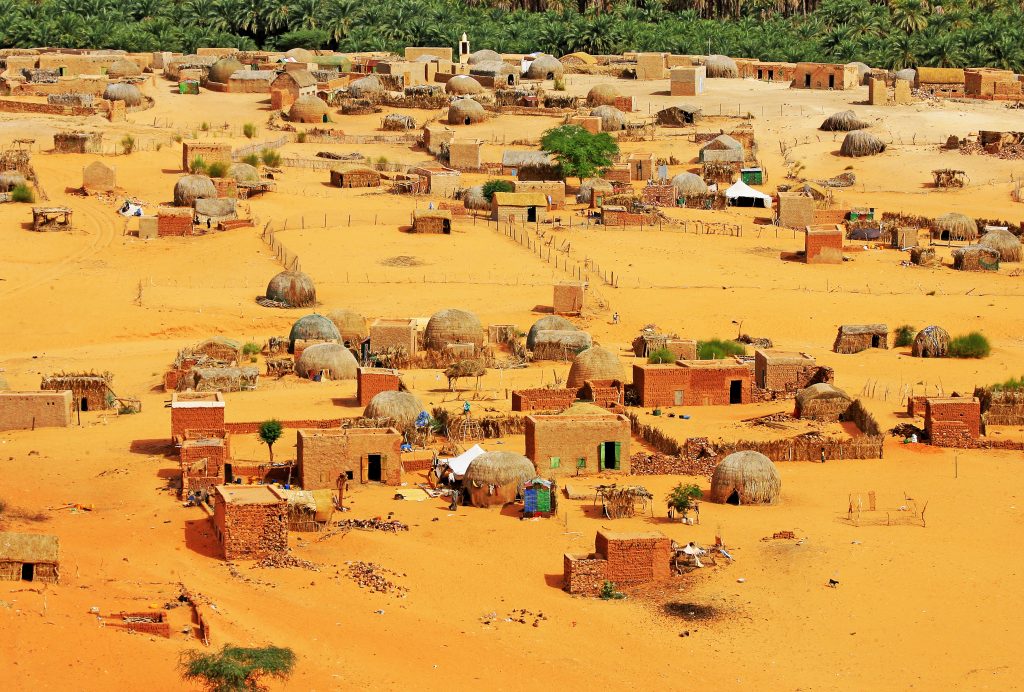
Ouadane: arrival in the fortified caravan city of Ouadane, founded in the 12th century, and lunch. We then explore the extraordinary hillside of ancient dry-stone ruins — street after street of collapsed houses, mosques and gates cascading down the slope — together with the palm grove and the small inhabited lower town.
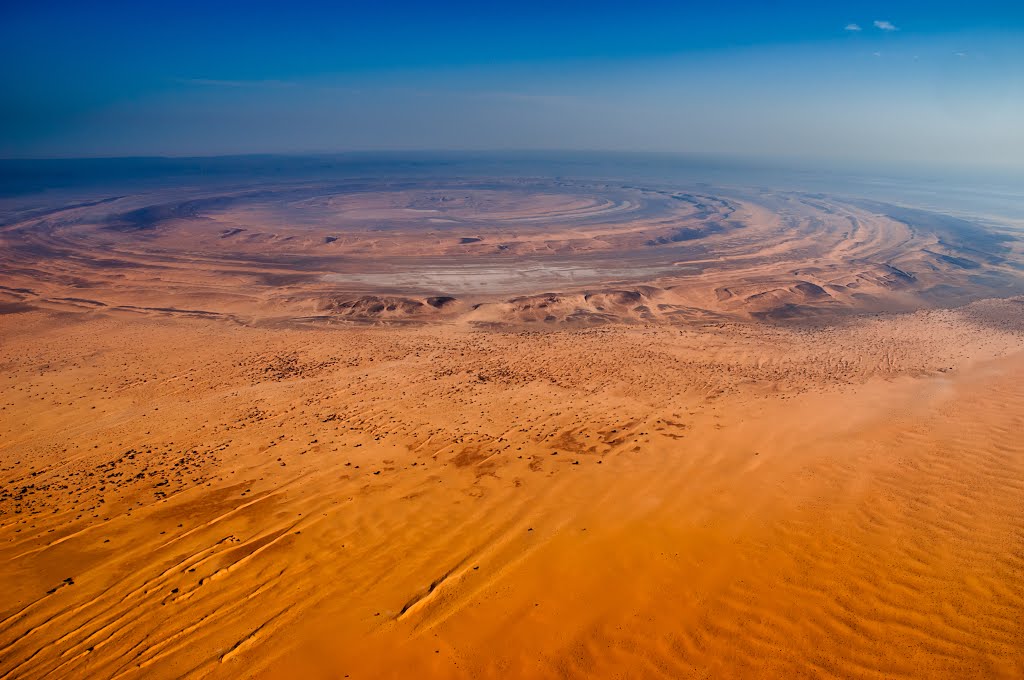
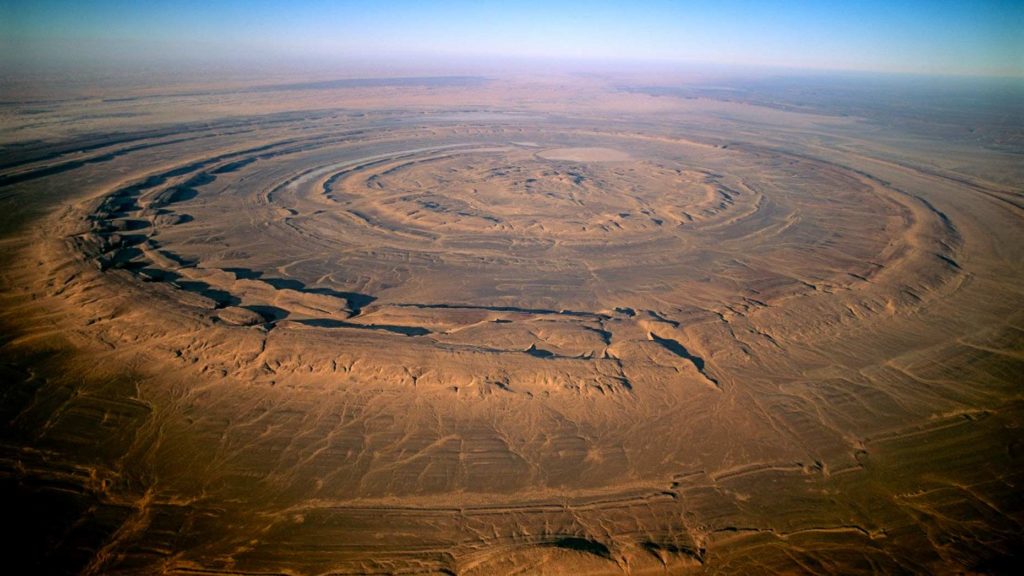
The Richat Structure — the Eye of the Sahara: in the afternoon we drive 30–45 km north-east of Ouadane (about 1.5–2 hours each way over flat, sandy desert) into one of the planet's great geological curiosities. The perfect "bullseye" is best seen from space — astronauts use it as a landmark — but standing inside the 40-km-wide formation is a thrilling experience of scale and isolation: we drive through the sweeping concentric rocky ridges and can climb the central area for the view.
About Ouadane and the Richat Structure: Ouadane was founded around 1141–1147 by Berber scholars and became one of the richest caravan terminals of the Sahara — gold, salt and dates passed through its gates, and Portuguese traders even attempted to establish a trading post here in the 15th century. Like Chinguetti, it is a UNESCO World Heritage site; its ruined old town is among the most dramatic sights in West Africa. The Richat Structure is not a meteorite crater, as long believed, but a deeply eroded geological dome: alternating rings of hard and soft rock, over 100 million years old, carved by wind and time into a giant eye 40 km across. Geologists still come from all over the world to study it.
Night: auberge (guest house) in Ouadane.
-
7
Amogjar Pass, Atar, and the Almoravid Capital of Azougi
Atar and the Adrar →Ouadane → Atar: approx. 180 km, about 3 hours over rugged, unpaved desert tracks.
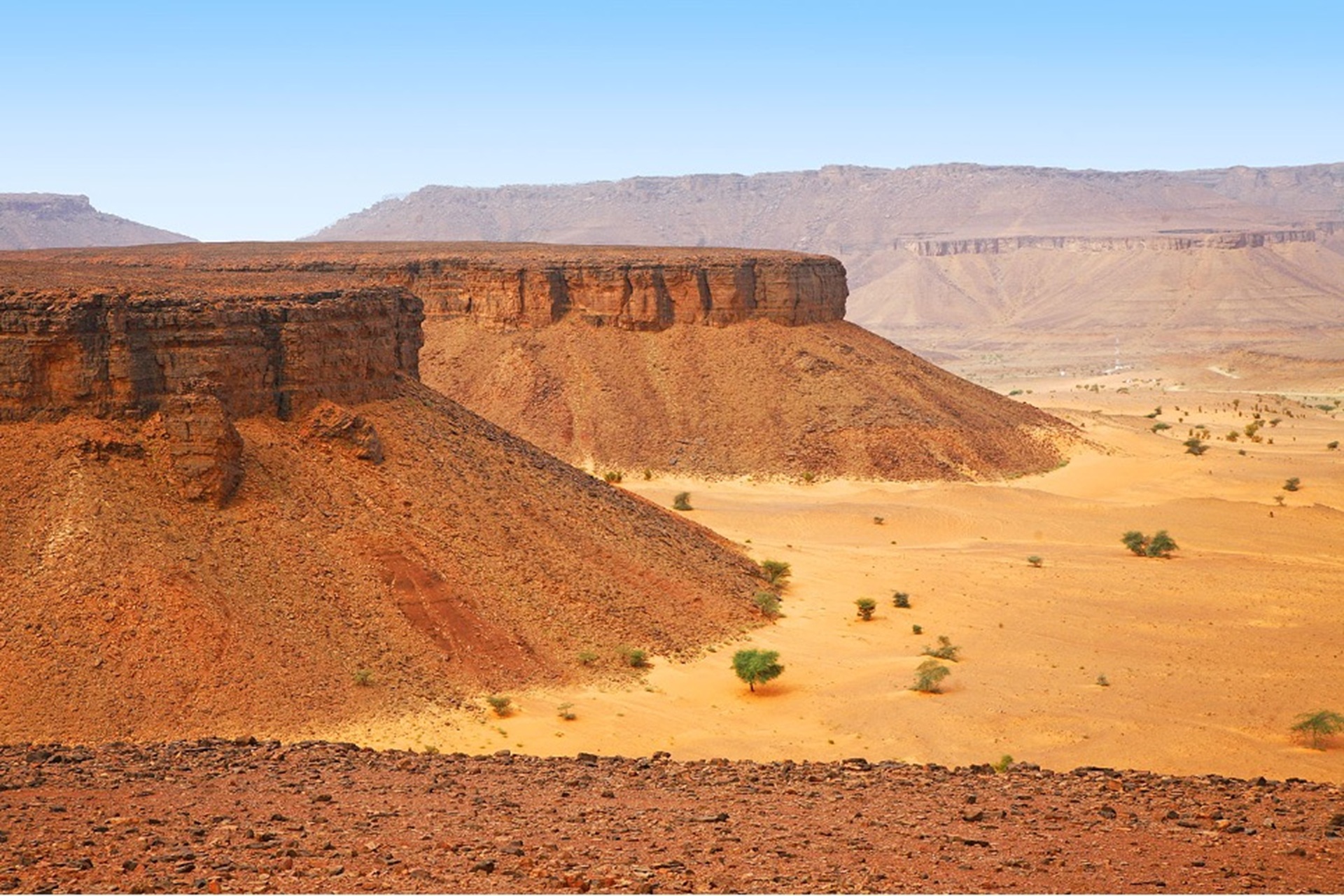
Amogjar Pass, the Agrour Rock Art and Fort Saganne: we take the breathtaking mountain route through the Amogjar Pass (also called the Ebnou Pass) — a scenic 4x4 drive through cliffs and canyons of the Adrar plateau. On the way we stop at the Agrour rock-art site, where paintings thousands of years old show giraffes, cattle and hunters — proof that this desert was once green savanna. Nearby stand the film-set ruins of "Fort Saganne", built for the 1984 French epic of the same name and slowly being reclaimed by the desert.
Atar: arrival in Atar and lunch in town. Atar is the principal city and capital of the Adrar region — a historic desert oasis that has always served as a vital caravan stop, the regional hub of the date trade, and today the gateway for all Sahara travellers. We visit the old quarter with the Atar Mosque, constructed in 1674 and one of the oldest in the country, and browse the craft markets: the city is a prominent centre of traditional weaving, rugs and leatherwork.
Azougi — Cradle of the Almoravids: in the late afternoon a short drive brings us to the palm-filled valley of Azougi, where we camp for the night among the gardens.
About Azougi and the Almoravid Empire: in the mid-11th century the Almoravid movement was founded in the western Sahara by nomadic Sanhaja Berber tribes (principally the Lamtuna and Gudala) under the spiritual guidance of Abdallah ibn Yasin. Azougi was chosen as their central military and political base — in effect the first Almoravid capital. The oasis was fortified with a dry-stone citadel and defensive walls, whose remains can still be traced today. From this valley the Almoravid conquests swept southward to the Ghana Empire, northward across Morocco — where they founded Marrakesh — and over the Strait of Gibraltar into the Iberian Peninsula. Standing among these quiet palm groves, it is astonishing to think an empire stretching from Senegal to Spain began here.
Night: camp in the oasis of Azougi.
-
8
Riding the Iron Ore Train across the Sahara
The Desert Train and Choum Station →The big moment is here! Today we drive to the small railway town of Choum, where we will board the legendary iron ore train. We wait in a comfortable space until the train arrives — it follows the rhythm of the mines, not a printed timetable, and our team tracks its progress.
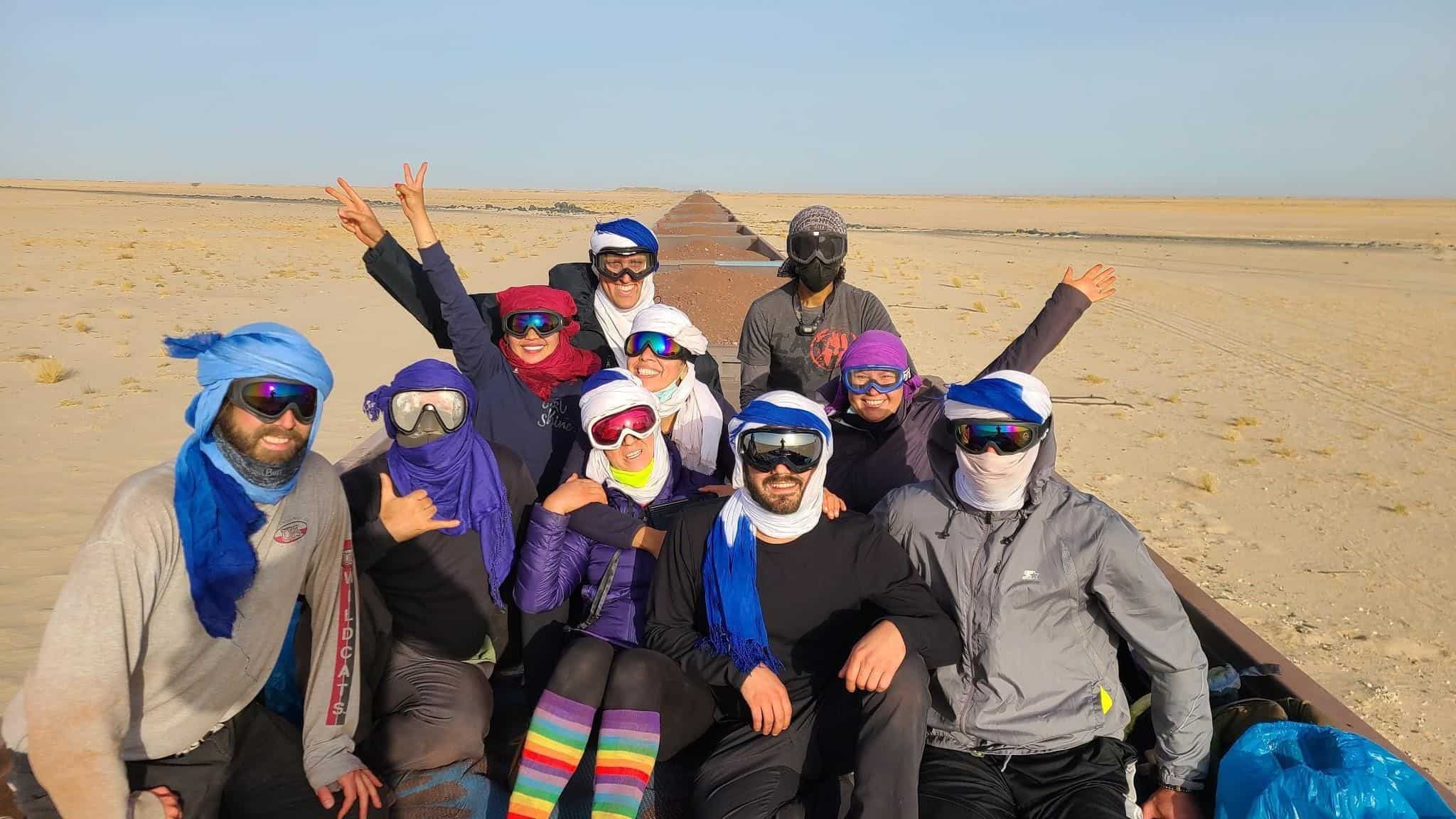
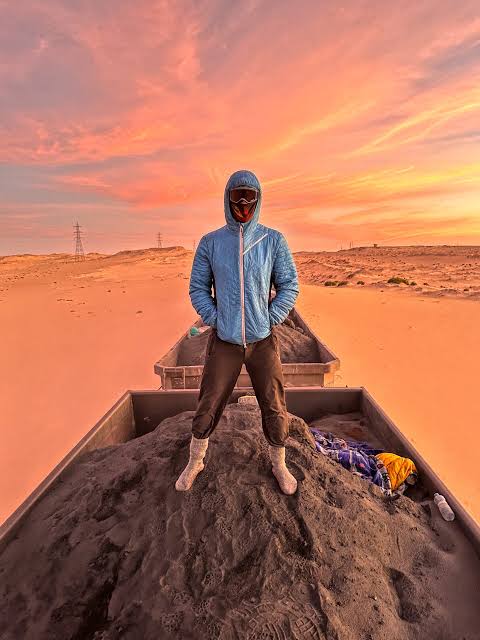
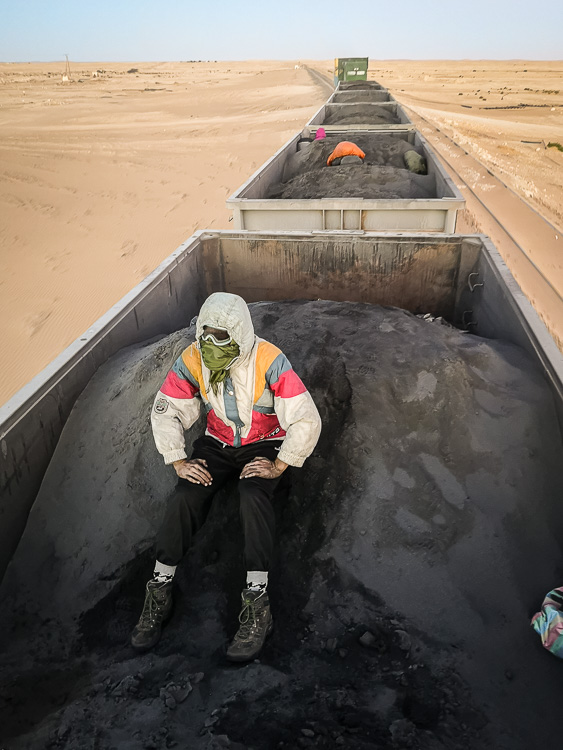
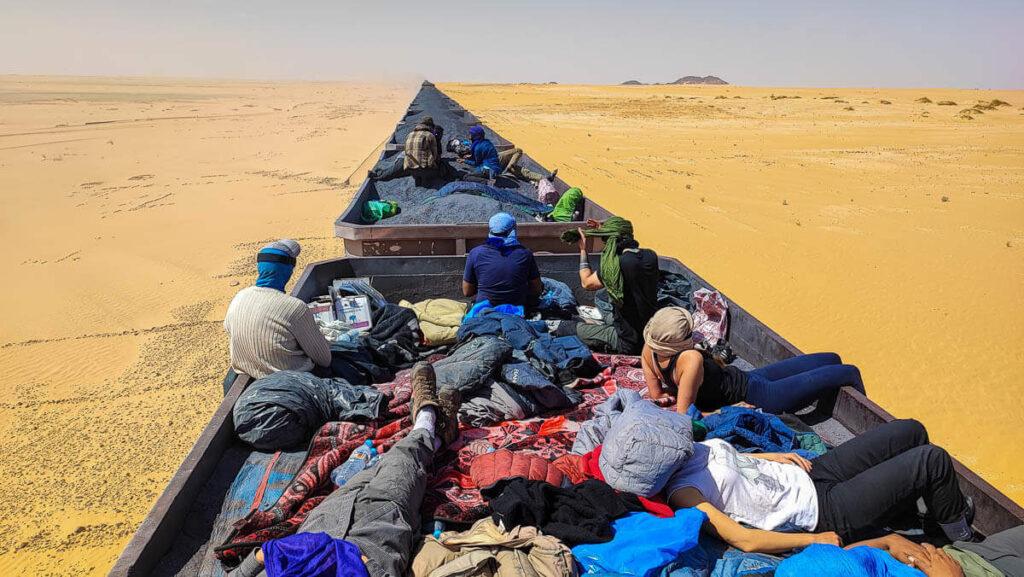
When it thunders in, we climb on top of an ore wagon, settle into the soft heaps of iron ore with our mattresses and blankets, and set off westward for an unforgettable night under the stars, rolling through the open Sahara towards the Atlantic coast.
About the Iron Ore Train: operated by the national mining company SNIM since 1963, the train carries iron ore 704 km from the mines of Zouerate to the port of Nouadhibou. With up to ~200 wagons and a length of 2–2.5 kilometres, it is one of the longest and heaviest trains in the world. Riding on top of the ore wagons is free, and for decades it has been the local "bus" for desert communities — sharing a wagon with the Sahara wind, the dust and the stars is considered one of the greatest adventure-travel experiences on earth.
Practical notes: we provide mattresses, blankets and food for the ride. Bring warm layers (desert nights are cold and the wind is constant), a scarf or cheche to cover your face, ski-style goggles for the dust, a headlamp, and keep cameras in sealed bags — the fine iron dust gets everywhere. It washes off easily; the memory does not.
Night: on top of the train, crossing the desert.
-
9
Nouadhibou: the Atlantic at Last
Nouadhibou →In the early hours the train reaches the coast and we climb down — dusty, happy and full of stories. We transfer to our hotel in Nouadhibou to shower, rest and enjoy a proper breakfast.
Later in the day we explore at an easy pace: the fishing harbour — Nouadhibou is Mauritania's fishing capital: pirogues, trawlers and fish markets in constant motion. The Cap Blanc (Cape Nouadhibou / Ras Nouadhibou) peninsula: wild Atlantic scenery at the tip of the peninsula, and with luck a glimpse of the Mediterranean monk seal, one of the rarest marine mammals in the world. The ship graveyard: rusting hulls scattered along the bay — once one of the largest ship cemeteries anywhere, still hauntingly photogenic. And a fresh seafood dinner: after a week of desert cooking, the fish here tastes like a celebration.
About Nouadhibou: Nouadhibou lies in the far north-west of Mauritania, on the Cap Blanc peninsula facing a protective bay of the Atlantic. It developed first as a fishing centre — and fishing remains essential — but since 1964, with the completion of a special ore pier and the 704-km railway to the "Iron Mountains" near Zouerate and Fdérik, the port's main economic weight has rested on exports of high-grade iron ore. It is the country's second city and economic capital. Not far down the coast begins Banc d'Arguin National Park, a UNESCO World Heritage site since 1989 — one of the most important bird sanctuaries on the planet, where millions of migratory birds winter between the Sahara and the sea.
Night: hotel in Nouadhibou.
-
10
The Great Return
Nouakchott →Nouadhibou → Nouakchott: approx. 470 km on the paved coastal highway, 5–6 hours.
After breakfast our jeeps pick us up from the hotel for the drive back to Nouakchott. The road runs south along the edge of Banc d'Arguin National Park — dunes on one side, the Atlantic on the other — with stops for photos and lunch on the way.
In Nouakchott we freshen up, share a last meal and say our goodbyes before your transfer to the airport for the departure flight — taking home iron dust in your shoes and the whole Sahara in your memory.
---
Price includes
- Airport transfers and all transport in private 4x4 vehicles with professional desert drivers; an English-speaking guide for the whole itinerary; all accommodation: hotels, guest houses and equipped desert camps; full board (meals, drinking water, tea) from Day 1 dinner to Day 10 lunch; the iron ore train ride with mattresses, blankets and provisions; and all entrance fees (libraries, museum) and local community contributions.
Not included
- International flights and visa (visa on arrival available at the airport); travel insurance (mandatory); personal expenses and souvenirs; and tips for the team — guides, drivers and camp crew: not included, left to your discretion; customary and warmly appreciated at the end of the trip.