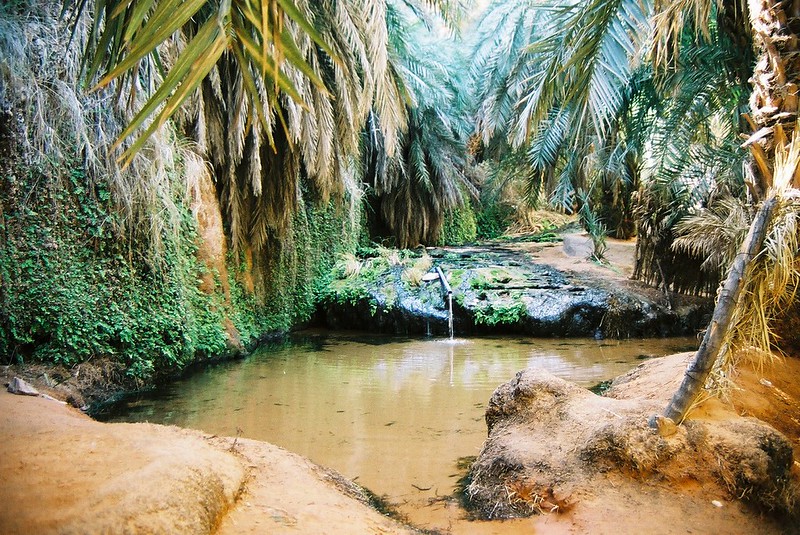
Running water in a rock gorge, in the middle of the Adrar plateaus — that is what surprises people at Terjit. A small oasis fed by cold Saharan springs and a few warm ones, at the far north of the Ouajeft department, 45 kilometres south of Atar. Date palms cover most of the gorge floor, along with acacias, myrobalans, climbing plants and mosses — and fig trees, which Terjit alone has in Mauritania. People have lived here since the nineteenth century; around the oasis today there are a few houses, a mosque, and lodgings for visitors. The nearest village is Oued Amheirt, home to Amheirth oasis, the largest in the Adrar and one of those that feed Terjit. Fish still live in the water, but drought and desertification threaten them — a small detail that says a great deal about how fragile this place is.
Terjit Oasis
What to see
Varesse Oasis (Adrar) — A Palm Haven between Terjit and the Zarga Mountains
The oasis of Varesse (also written Farès or Faress) is a haven of calm in Mauritania's Adrar region. Tucked into the heart of the mountain massif between the oasis of Terjit and the spectacular Zarga mountains, it lies a few kilometres south-east of Mhaïreth and 65 km from the town of Atar. Its palm grove is one of the 63 picturesque oases scattered through the canyons and sandstone plateaus of the Adrar, an area that often serves as a departure point for camel treks into the Sahara. Between the shade of the palms and the sandstone walls, Varesse offers travellers a rare pause from the heat of the track and the silence of the stone.
Ntezent (Adrar) — A Desert Base between Terjit and the Erg Nouakane
Ntezent is an essential stop on any camel trek or 4x4 circuit in Mauritania's Adrar region. Lying immediately beside the famous palm grove of Terjit and the Erg Nouakane, it is an ideal starting point for exploring the canyons and ochre sand dunes of the desert. Its value lies above all in being a base rather than a monument in itself: excursions into the wadis and the dunes begin here, without the need to return to Atar each time. Within a short radius the area brings together three contrasting scenes — palms and water at Terjit, ochre sand in the Erg Nouakane, and the rock walls of the canyons. Travellers come to walk the valleys and side gorges, to climb the dunes at sunset and slide down them, to camp and watch the stars in skies free of light pollution, and to share tea with nomad families and see their camel herds. The best season runs from October to March; access is by tracks that require a 4x4, there are no services on site, and water, fuel and supplies must be taken from Atar, ideally with a local guide.